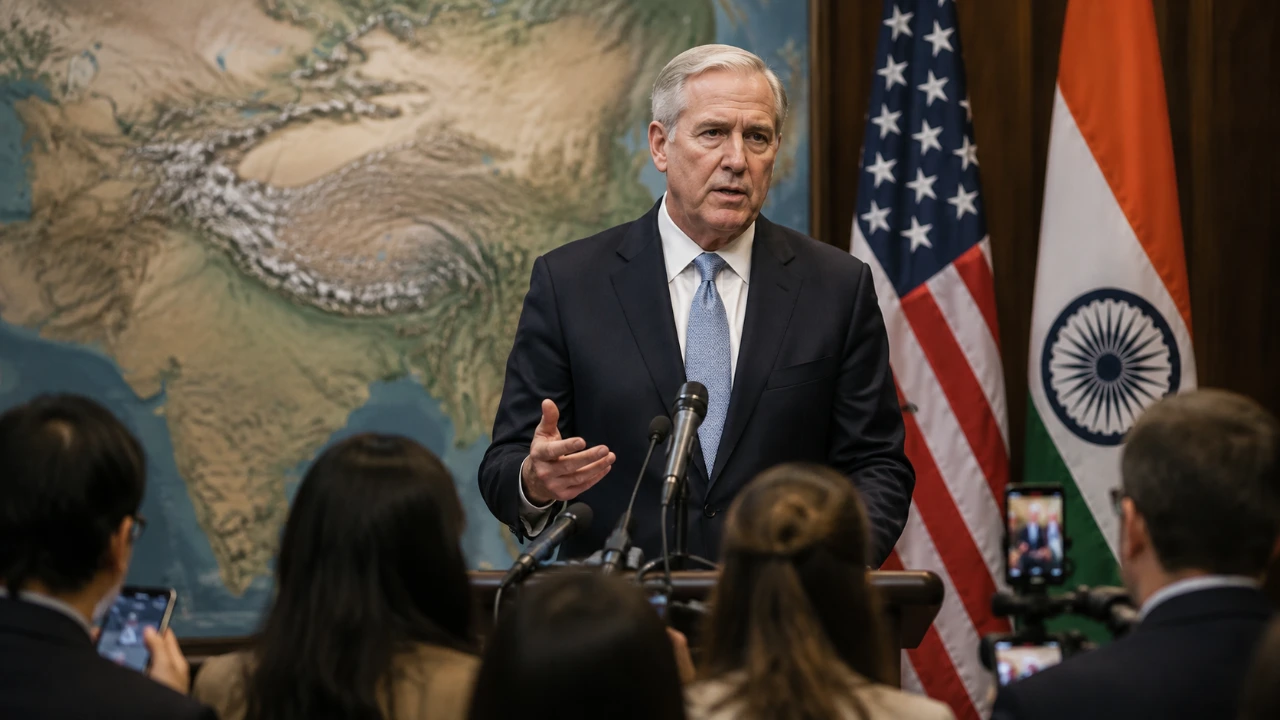
The recent remarks by US Ambassador Sergio Gor on Jammu and Kashmir have reopened an old debate over India-US relations and Washington’s Kashmir policy. India has consistently maintained that Jammu and Kashmir is an integral part of the country. The US, meanwhile, has historically emphasized resolving the issue through dialogue between India and Pakistan while also taking into account the wishes of the people of Kashmir.
Against this backdrop, Gor’s comments are being viewed as a possible indication of a shift in the US position. However, it would be too early to conclude that Washington’s broader policy has changed based on a single diplomatic statement.
How Has the US Position on Jammu and Kashmir Evolved?
In its earlier approach to the Kashmir issue, the US supported the idea of a plebiscite under relevant United Nations resolutions. Over the years, however, Washington’s position evolved, with greater emphasis placed on resolving the dispute through dialogue between India and Pakistan.
It is in this context that the reported remarks describing Jammu and Kashmir as an essential part of India have attracted attention. The comments are also being compared with a statement made by a senior US official more than three decades ago, which triggered a strong reaction in India.
Why Is the 1993 Statement Being Revisited?
In October 1993, then US Assistant Secretary of State for South Asian Affairs Robin Raphel described Kashmir as a disputed territory during a briefing with journalists in Washington.
Raphel also said that the United States did not recognize the Instrument of Accession signed by Maharaja Hari Singh in a way that meant Jammu and Kashmir was permanently an integral part of India.
Her remarks created unease in India-US relations at the time. Then Prime Minister P.V. Narasimha Rao described the US statement as “pinpricks and minor mischief.” The Indian government also formally expressed its objections to Washington.
The US State Department later clarified that there had been no change in America’s basic policy on Kashmir.
Has the Picture Changed Three Decades Later?
More than three decades later, Sergio Gor’s remarks have brought that 1993 episode back into the conversation. However, the political context today is different.
While the 1993 US statement was viewed as a source of concern in India, the latest comments are being seen as potentially uncomfortable for Pakistan. This has led to fresh speculation about whether Washington’s approach to Kashmir could be changing.
If the US is genuinely moving away from its earlier position on Jammu and Kashmir, it could have implications for India-Pakistan relations and the wider international diplomacy surrounding the issue.
For now, however, it would be premature to treat a single diplomat’s remark as evidence of a permanent change in US foreign policy. Washington’s official statements and future comments from senior American officials will be more important in determining whether the latest remarks represent a one-off statement or the beginning of a broader policy shift.